logo

SAL
Catrion
STC
Bank Albilad
One Banking
PIF
SELA
Ma'aden
Riyad Bank
Genalive
Enjoy
Meem Bank
Project
Project
Project
Project
Project
Project
Project
Project
Project
Project
Project
Project

Start a Conversation

Hi! Click one of our member below to chat on WhatsApp

Annual Report Design in Saudi Arabia: The Complete 2026 Playbook

Many listed companies spend five months producing their annual report and five minutes deciding what it should say to investors. In the current regulatory environment, compliance has become a baseline metric. For a Chief Financial Officer or Head of Investor Relations at a Tadawul-listed corporation, the annual report is the single highest-leverage narrative asset available to shape market perception, align with sovereign economic priorities, and secure international capital.

When an organization treats this asset as a graphic design exercise, it abdicates its strategic narrative. A visually over-engineered report that lacks a cohesive, rigorous data structure signals to investors that a company is masking operational gaps with creative flourish. Conversely, an unbroken wall of regulatory prose ensures your strategic milestones remain unread. Navigating this delicate balance requires an institutional partner who understands that a winning annual report design in Saudi Arabia for the 2026 reporting cycle is about building corporate trust.

beyound-img

The Shift from Compliance to Conviction

The institutional landscape across the GCC has matured beyond simple disclosure. The introduction of unified regional reporting mandates, evolving corporate governance standards, and strict sustainability transparency rules mean that a report must bring together information from across the organization in a coherent and consistent manner. It must satisfy local auditing authorities while simultaneously providing international fund managers with institutional clarity.

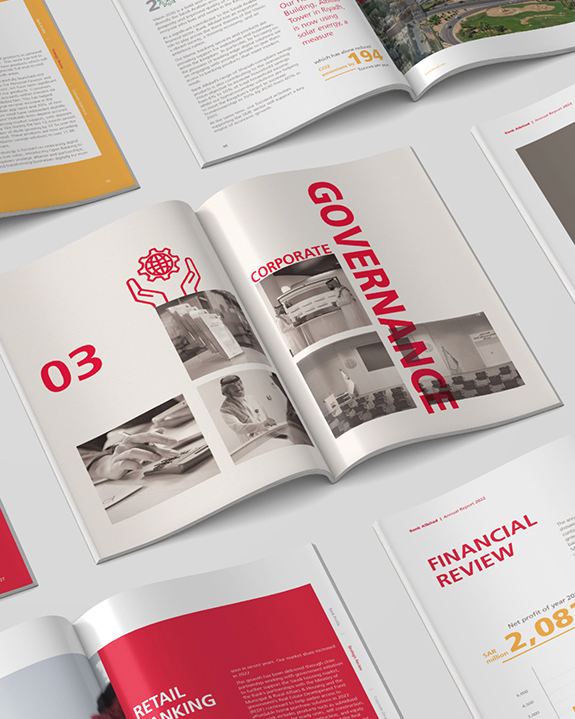
An annual report is the story of an organization told through a standardized financial framework. If your visual presentation separates your strategic narrative from your financial disclosures, the document loses its cohesive authority. The process for an annual report design in Saudi Arabia must treat the front-end strategic review and the back-end financial tables as an integrated ecosystem, where typography, layout rigor, and data visualization maintain absolute consistency. Organizations can observe this unified structure in practice by reviewing our regulatory reporting architecture for the Bank Albilad 2024 Annual Report.

The 2026 Strategic Reporting Framework

To build an annual report that serves as a permanent corporate asset, teams must structure their content across four non-negotiable narrative pillars.

01. The Sovereign Alignment Vector

The report must explicitly map corporate milestones against national transformation objectives, including specific Vision 2030 delivery programs, localized industrial targets, and regional infrastructure integration.

02. The Integrated Capital Model

Move beyond pure financial reporting to articulate how your enterprise leverages intellectual, human, manufacturing, and social capitals to sustain long-term market depth.

03. Bilingual Data Parity

Financial tables, operational charts, and strategic infographics must be engineered for simultaneous right-to-left (Arabic) and left-to-right (English) readability without compromising typographic scale or layout symmetry.

04. The Forward-Looking Risk Architecture

The risk disclosure section should detail operational mitigation strategies, market stress-testing, and corporate resilience models to provide stakeholders with a clearer understanding of the organization's preparedness.

Preventing Narrative Drift and Material Misstatement

A major operational bottleneck during corporate reporting cycles is the disconnect between investor relations teams and external production houses. When corporate copy is altered independently of the visual grid, errors emerge. A decimal point shifted or an infographic metric misaligned can alter an entire performance indicator, leading to regulatory scrutiny or market misinterpretation.

Developing a high-performance framework for your annual report design requires a strict operational protocol where narrative architecture precedes visual execution. The strategic review and management discussion analysis (MD&A) must be locked alongside the numbers. When design tokens and automated data ingestion models are established through our specialized strategic reporting and investor relations services, any last-minute adjustments by auditors update seamlessly across both language layouts without requiring manual layout reconstruction, safeguarding the precision of your corporate record.

Auditing Your Corporate Narrative

Before entering the design production phase, financial leadership must evaluate the integrity of their current asset. The diagnostic framework below identifies structural narrative gaps that undermine enterprise trust.

Does the strategic review section use verified, proprietary operational data rather than generic sector commentary?

Are all financial infographics directly cross-referenced with audited footnotes in the back-end tables?

Does the report maintain absolute bilingual parity in typographic weight across both layout orientations?

Is your corporate governance disclosure explicitly structured around current Tadawul and CMA requirements?

Does your narrative link capital expenditure directly to explicit three-year growth targets?

If your reporting team records more than two negative responses, your foundational architecture requires remediation before creative formatting begins.

The Visual Rhythm of Institutional Data

Long paragraphs of dense financial exposition fail to retain the attention of senior analysts or institutional stakeholders. Visual rhythm is the structural methodology used to guide an executive reader through complex compliance data without sacrificing analytical rigor. The matrix below outlines how structured layout adjustments transform standard disclosure prose into clean, scannable data.

Data Type Standard Prose Treatment (To Avoid) Structured Table Treatment (The Spark Model)
Segmental Performance Long paragraphs listing regional revenue variations and operational margins across three distinct corporate divisions. A structured comparative matrix matching geographic revenue splits with net operational margins and trailing three-year growth percentages.
Board Governance A continuous list of director biographies, historic committee assignments, and generalized statements regarding board independence. A definitive skills-matrix grid mapping directorship tenures, specific institutional competencies, and attendance ratios against individual committee seats.
Capital Allocation Descriptive prose detailing annual investment cycles, general project funding, and high-level descriptions of ongoing capital expenditures. A sequential deployment framework contrasting initial budget estimates, actual year-to-date expenditure, and projected multi-year returns on capital.
Sustainability Metrics General corporate social responsibility narratives combined with non-standardized statements on resource reduction. A tokenized ESG index mapping verified carbon metrics, water consumption rates, and localization percentages against international reporting baselines.

The GCC Reality Check

Executing enterprise-grade annual report design in Saudi Arabia demands deep literacy in the specific corporate mechanics of the region. As regional sovereign wealth funds and international institutional investors increase their stakes in local capital markets, annual reports must step away from descriptive corporate summaries and move toward rigorous, evidence-based disclosures.

This evolution requires technical precision in bilingual design. Typographic selections must ensure that Arabic script maintains its structural elegance and legibility alongside complex financial data points, multi-column tables, and numeric notations. Furthermore, the narrative must accurately reflect compliance with localized labor initiatives, regional data residency mandates, and specific corporate tax architectures without losing the high-level investment thesis.

The Architecture of Digital IR Platforms

In 2026, the traditional print-first approach to corporate disclosure is insufficient for modern investor relations. While a compliance PDF remains a regulatory necessity for Tadawul filings, international asset managers and local retail investors consume performance data across dynamic, screen-optimized environments. True innovation in annual report design in Saudi Arabia treats the digital interactive report as a core product.

An interactive investor relations portal scales your corporate narrative by enabling analysts to extract raw data, toggle performance metrics, and filter financial footnotes directly within a web interface. This infrastructure allows your financial leadership team to capture analytics on which operational sectors are attracting the highest institutional interest. Transitioning to an integrated digital reporting system ensures your enterprise meets the accessibility expectations of a global investment audience while establishing a continuous channel of communication.

Procurement and Production Hazards

CFOs and IR directors must manage the annual reporting lifecycle to avoid typical execution bottlenecks. The table below details the essential operational contrasts for corporate reporting teams.

Actions We Recommend Things to Avoid

Lock the core strategic narrative and data structure before initiating layout design.

Allow design layout production to begin while financial figures remain unaudited.

Build tokenized, scalable charts that link directly to underlying financial databases.

Utilize static, flat vector graphics that require manual revision for every draft change.

Require case studies showing long-term brand system management for regional institutions.

Rely on portfolios that only showcase consumer-facing launch advertising.

Grade agency capabilities based on institutional compliance literacy and data precision.

Select a design partner based purely on superficial creative agency credentials or aesthetic rewards.

A disciplined annual report deployment requires a sequential timeline that respects regulatory deadlines while preserving narrative quality.

FAQs

How do we balance localized national positioning with international investor expectations?

Frame your sovereign alignment as a concrete commercial advantage. Do not rely on generic national rhetoric; instead, show how your participation in regional transformation initiatives de-risks your capital investments and accelerates your long-term revenue pipelines.

Why do traditional graphic design agencies routinely fail at financial reporting projects?

Traditional agencies specialize in marketing campaigns, not data-dense corporate governance. They prioritize abstract aesthetics over compliance layout rules, leading to disjointed data visualizations, asymmetric bilingual tables, and systemic layout failures when meeting regulatory audits.

When should our organization transition from static digital reports to interactive web-based IR experiences?

The transition should occur immediately if international institutional funds hold more than fifteen percent of your free float. Global analysts require data that can be dynamically parsed, filtered, and integrated directly into their internal valuation models.

Related Articles

Deep dives into what matters